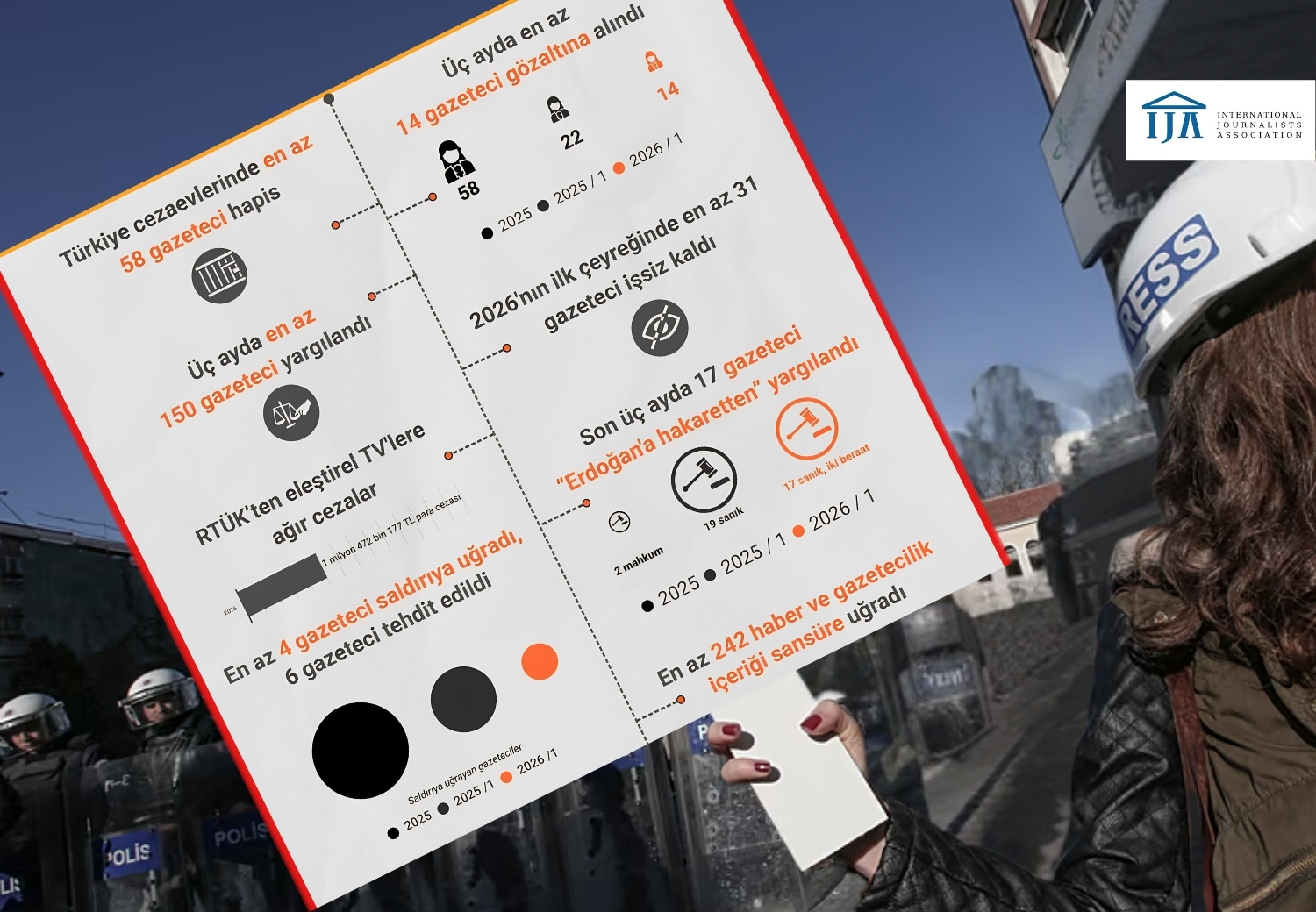
According to the BIA Media Monitoring Report, at least 58 journalists were in prisons in Turkey during the first three months of 2026, while 14 journalists were detained and 150 were put on trial. In the same period, 4 journalists were attacked, 6 were threatened, 242 pieces of news content were censored and 31 journalists lost their jobs.
The report by BIA Media Monitoring, covering January-February-March 2026, shows that judicial, administrative and physical pressure on journalists in Turkey continued in the first quarter of the year. According to the report, journalists faced multidimensional rights violations, including detention, prosecution, imprisonment, attacks, censorship and unemployment.
Data in the report indicate that at least 58 journalists were in Turkish prisons during the first quarter of the year. In the same period, at least 14 journalists were detained and at least 150 were prosecuted. This picture shows that journalistic activities are being heavily subjected to criminal investigations.
Criminal cases against journalists during the three-month period also stood out. At least 17 journalists were tried under Article 299 of the Turkish Penal Code on charges of “insulting the president” referring to Recep Tayyip Erdoğan. While two convictions were handed down in these cases, some journalists were acquitted.
Charges brought against journalists included insulting the president, spreading “misleading information”, making terrorist propaganda and threatening public order. Rights groups state that prosecutors frequently use these charges together with short-term detention and arrest measures, which disrupt journalism and limit journalists’ ability to work.
Among the prominent cases was the arrest of investigative journalists Alican Uludağ and İsmail Arı under Article 217/A of the Turkish Penal Code, widely known as the “disinformation law.” Critics argue that the regulation contains broad wording and allows prosecutors to act against news reports deemed controversial.
Journalist Furkan Karabay was placed under house arrest, restricting his freedom of movement, while some journalists were banned from traveling abroad. The same provision was also used in cases against journalists covering investigations into the Istanbul Metropolitan Municipality.
A foreign journalist was also among those detained. French reporter Raphaël Boukandoura was detained while covering a protest in Istanbul and was later released from a deportation center.
According to the report, at least 4 journalists were physically attacked and at least 6 were threatened in the first quarter of the year. Among those attacked was journalist Durmuş Tuna, who was shot in the leg in Aydın. These cases once again highlight the safety risks journalists face in the field.
Censorship practices were also a key issue in the report. During the three-month period, at least 242 news articles and journalistic content items were censored through access-blocking or removal decisions. Most of these decisions were reportedly justified on the grounds of national security and public order.
The actions of regulatory bodies also drew attention. The Radio and Television Supreme Council imposed administrative sanctions, particularly on critical television channels, issuing fines totaling 1,472,177 Turkish Lira.
Meanwhile, under rulings by the Constitutional Court of Turkey concerning violations of freedom of expression, compensation totaling 36,500 Turkish Lira was awarded in the first quarter of 2026. This indicates that violations of freedom of expression remain a structural problem.
The economic downturn in the media sector was also reflected in the report. At least 31 journalists lost their jobs in the first three months of the year, highlighting the economic consequences of insecurity and pressure in the sector.
According to Expression Interrupted, which tracks press freedom cases, 26 journalists are currently in prison in Turkey. In the latest World Press Freedom Index by Reporters Without Borders, Turkey ranked 163rd out of 180 countries.
Legal cases also targeted journalists and media organizations. Lawsuits seeking a total of 4.65 million Turkish Lira (approximately $145,000) in damages were filed against five journalists and three media outlets. According to the report, plaintiffs included well-known public figures and individuals linked to the government.
Regulatory authorities also took steps against broadcasters. Turkey’s media watchdog, Radio and Television Supreme Council (RTÜK), imposed fines on television channels and issued warnings regarding licensing requirements. Critics argue that these measures disproportionately affect media outlets critical of the government.