The 2025-2026 Press Freedom Report published by the Journalists’ Union of Turkey reveals that violations against journalists continued between April 2025 and April 2026 within a systematic and institutionalized regime of pressure. The report identifies Article 217/A of the Turkish Penal Code – dubbed the “Censorship Law” – as the greatest obstacle to press and freedom of expression.
Prepared by TGS, the Press Freedom Report was shared with the public for the seventh time on World Press Freedom Day, May 3. It presents a comprehensive picture of rights violations against journalists and media institutions during the April 2025-April 2026 period.
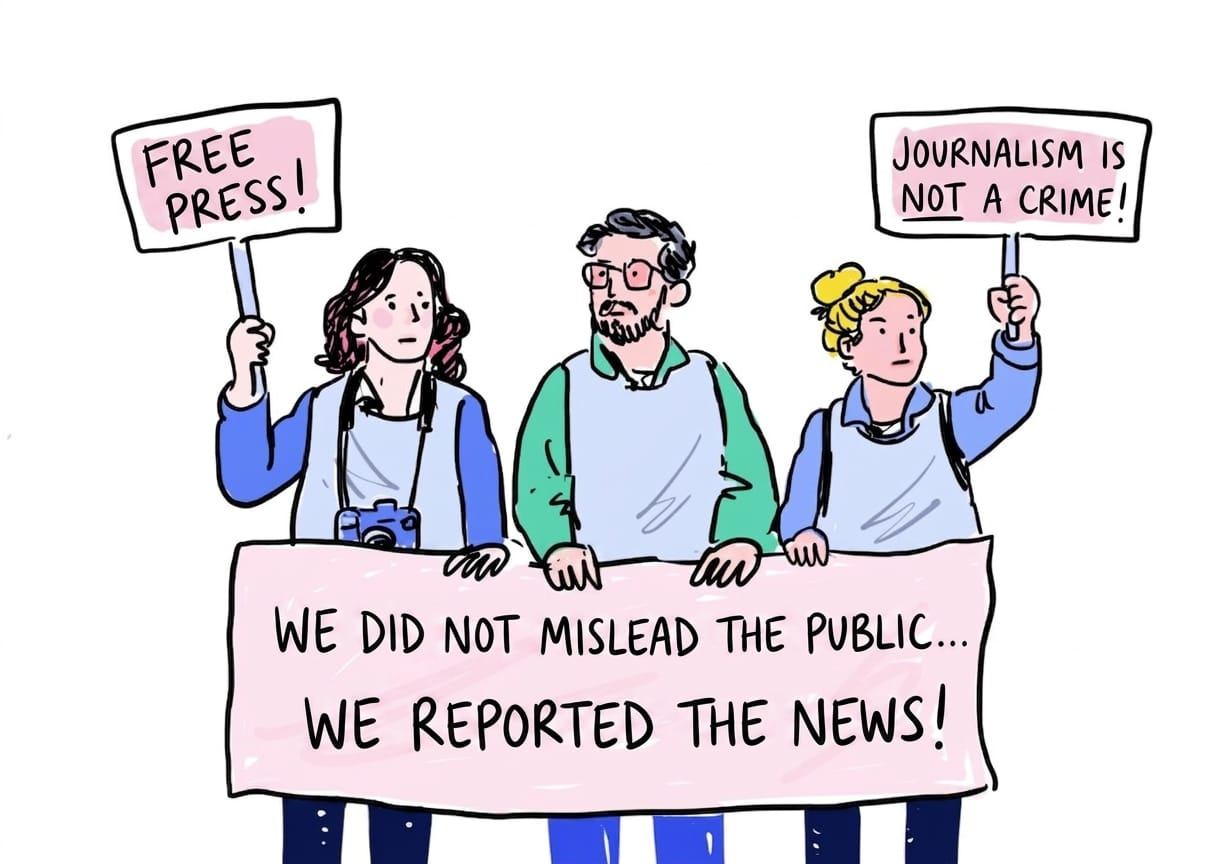
The report notes that World Press Freedom Day in Turkey is once again marked by mounting problems, emphasizing that the country has fallen to 163rd place out of 180 countries in global press freedom rankings. According to the report, Article 217/A of the Turkish Penal Code Article 217/A – criminalizing the “public dissemination of misleading information” – has become an issue affecting all segments of society, with journalists as the primary targets, and is directly undermining press and freedom of expression.
TGS stated that, as in previous years, journalists in Turkey marked May 3 under investigations, detentions, arrests, and judicial control measures, while also facing deepening precarity and poverty.
Finding: Institutionalized pressure
The report concludes that interventions against the press are not isolated incidents but are reproduced within an institutionalized system of pressure. It states that in a period where the rule of law has been replaced by the arbitrariness of those in power, constitutional guarantees have become ineffective, and journalistic activities continue to be systematically subjected to criminal and administrative sanctions.
Special focus on the “Censorship Law”: Article 217/A
A dedicated section of the report examines Article 217/A, which entered into force in 2022 and has been labeled the “Censorship Law” by press organizations. Its implementation practices and impact on journalism are analyzed in detail.
According to the data:
- 113 investigations were launched against 88 journalists.
- 29 journalists were detained, and six were arrested.
- One journalist was placed under house arrest.
- 49 investigations resulted in non-prosecution, while indictments were issued in 29 cases.
- Courts acquitted journalists in 15 cases, while 12 trials are ongoing.
- There are no finalized convictions under Article 217/A to date.
Judicial processes over the past year
Between April 2025 and April 2026, 19 journalists were tried in 16 criminal cases under Article 217/A. Seven journalists were acquitted in five of these cases, while trials involving 12 journalists are ongoing.
During the same period, 20 of 67 detention cases were based on Article 217/A. Following these detentions, two journalists were arrested, one was placed under house arrest, and 14 were subjected to judicial control measures such as regular reporting requirements and travel bans.
Arrests, trials, and penalties
As of April 1, 2026, at least 14 journalists are in prison due to their journalistic activities.
Between April 2025 and April 2026:
- 53 journalists were investigated,
- 67 were detained,
- 19 were arrested,
- two were placed under house arrest,
- 26 were subjected to judicial control measures.
The report notes that in many cases, investigations have effectively turned into a form of punishment. It also highlights that journalists are often detained at their homes and taken to cities hundreds of kilometers away.
Physical attacks and regulatory pressure
The report states that, as a result of impunity policies, at least 34 journalists were subjected to physical attacks and 22 to verbal threats and assaults.
It also highlights that decisions by the Radio and Television Supreme Council remain a key tool of administrative pressure on press freedom. A total of 15,154,715 Turkish lira in administrative fines were imposed across 21 decisions. Broadcasters such as TELE1, Halk TV, and SZC TV received program suspension penalties.
Internet censorship and broadcast bans
This year:
- At least seven websites were blocked,
- 41 news items were removed on a URL basis,
- 21 X (formerly Twitter) accounts were restricted.
The report emphasizes that broadcast bans and confidentiality orders are being used as tools to directly limit reporting on public events.
Call from TGS
In its conclusion, the report highlights that journalists are trapped between unemployment and lack of unionization, facing low wages and poor working conditions. Emphasizing the vital role of journalism in a democratic society, TGS called on all journalists to unionize, to struggle collectively, and to win together.