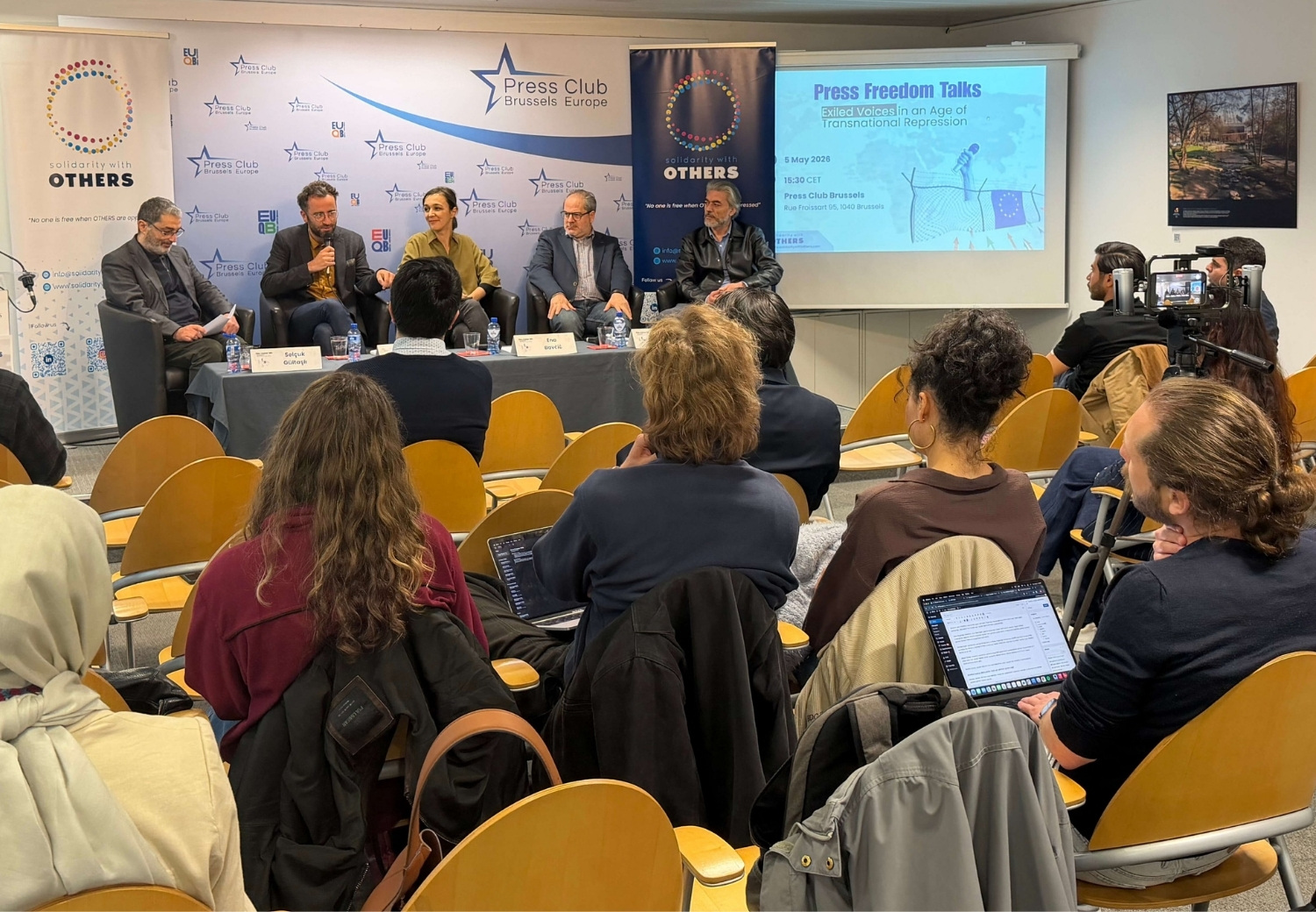
On the occasion of World Press Freedom Day, Solidarity With OTHERS organized the second edition of its Press Freedom Talks in Brussels. Held at Press Club Brussels Europe, the event focused on the situation of exiled journalists. Members of the International Journalists Association also participated in the panel.
The Belgium based NGO organized the second installment of the Press Freedom Talks in Brussels. The event addressed the situation of exiled journalists as a less visible yet increasingly urgent dimension of press freedom.
The panel brought together exiled IJA journalists, experts, and press freedom advocates to discuss the challenges of continuing independent journalism under exile conditions and the steps that could be taken at the EU level.
The first edition of the Press Freedom Talks, organized by Solidarity With OTHERS last year, focused on journalism in the digital age and how technology is reshaping the profession.
The panel, titled “Press Freedom Talks: Voices in Exile in the Age of Transnational Repression,” was moderated by journalist Selçuk Gültaşlı. Speakers included exiled journalist Levent Kenez, currently living in Sweden, and Syrian journalist Ebrahim Mahfoud, who lives in Belgium.
The panel also featured Ena Bavčić, senior EU officer at the European Centre for Press and Media Freedom, and Stephen Reimer, researcher and visiting lecturer at the School of International Affairs of Sciences Po Paris.
Gültaşlı draws attention to imprisoned journalists
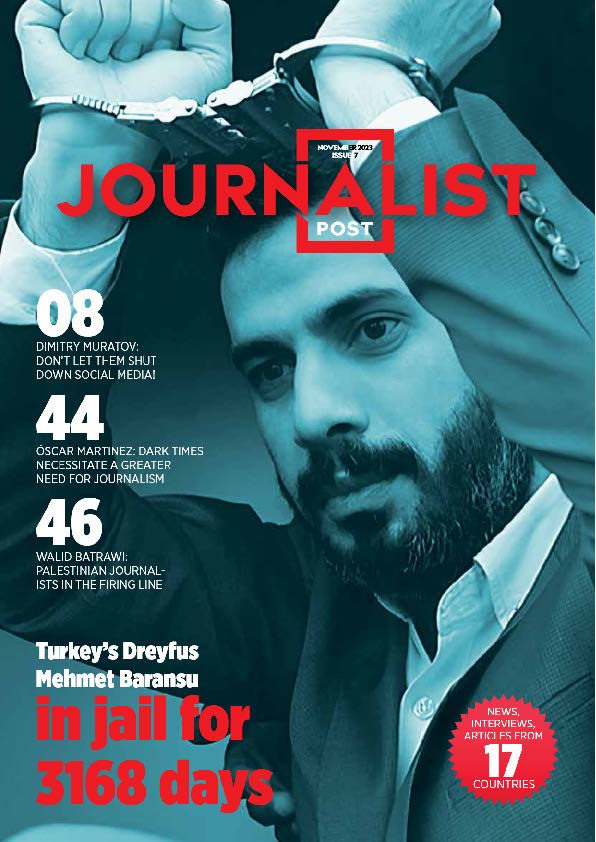
While introducing the program, Selçuk Gültaşlı highlighted not only the problems faced by exiled journalists but also the unjust imprisonment of journalists Hidayet Karaca, Mehmet Baransu, and Ali Ünal, who have been imprisoned in Turkey for more than nine years.
Stephen Reimer emphasized the cross-border repression carried out by authoritarian countries, stating that some international mechanisms are being used by these governments as tools of pressure against civil society. He said structures originally created to combat international crimes such as money laundering are being abused through various tactics to suppress journalists and dissidents. Reimer also noted that Interpol is among the institutions misused by authoritarian states, with Red Notices being one of the best-known tools of transnational repression.
Ena Bavčić stated that transnational repression affects not only journalists and targeted individuals but also society at large, especially family members. She stressed that journalists must deal not only with physical pressure but also digital threats. Bavčić added that the European Centre for Press and Media Freedom tries to assist journalists in many areas, including legal matters.
Kenez: “If Korucu had surrendered…”
IJA member Levent Kenez shared his experiences following July 15 and spoke about his life as an exiled journalist. He said he had been detained in Turkey over reports suggesting that state officials had prior knowledge of the events of July 15, and was later forced to leave the country.
As an example of state pressure against journalists, Kenez referred to the imprisonment of the wife of his colleague Bülent Korucu in order to threaten and pressure the journalist himself. Kenez said Korucu did not bow to these pressures, adding, “If Korucu had surrendered to these threats and pressures, the spouses, children, and families of many journalists and opposition figures in Turkey would have similarly become targets.”
Kenez also referred to Turkey’s demands for the extradition of journalists during Sweden’s NATO membership process and said that journalists were targeted by pro-government media during that period. He mentioned that one of his colleagues was physically assaulted in broad daylight. Kenez further stated that Turkish authorities tried intensely – but unsuccessfully – to block invitations for exiled journalists to speak at United Nations institutions. He also underlined that one of the biggest problems facing exiled journalists is censorship imposed through social media platforms.
Syrian journalist Ebrahim Mahfoud drew attention to the difficulties exiled journalists face in the countries where they settle. He said he had been prevented from practicing journalism in Italy because he did not possess a press card. In Belgium, however, he believes there is a more favorable environment for continuing journalistic work. Nevertheless, Mahfoud stressed that work opportunities remain very limited for exiled journalists and called for greater support and more opportunities for them.
“No place is safe enough”
The panel addressed the pressure tactics of authoritarian regimes, the challenges faced by exiled journalists, and the steps that should be taken at the EU level.
It was noted that the number of exiled journalists across Europe is steadily increasing, while the EU has not been able to provide them with full protection. Participants stated that “even after reaching European Union countries, journalists can continue to face surveillance, harassment, intimidation, legal pressure, and threats against their family members or colleagues in their home countries.”
The discussion highlighted how authoritarian governments continue to harass and threaten journalists who have fled abroad, drawing attention to the growing phenomenon of transnational repression aimed at silencing critical voices beyond national borders.
Journalists also raised issues such as legal uncertainty, financial instability, isolation, and obstacles to continuing their professional work while in exile.
IJA’s Exiled Journalists Report presented at the UN
The International Journalists Association report titled “Journalists in Exile,” submitted to the UN Special Rapporteur in 2024, highlighted the threats faced by journalists and the obligations of host states to protect them. The Parliamentary Assembly of the Council of Europe has described transnational repression as a growing threat to human rights, democracy, and the rule of law, while the European Parliament is preparing to vote in the coming months on a second report concerning transnational repression.
Although international institutions and organizations have taken important steps, major gaps remain in implementation and in the protection of journalists.
New report from OTHERS
Alongside the panel, Solidarity With OTHERS also published a report titled “Voices in Exile in the Age of Transnational Repression.” The report is based on interviews with 35 journalists from around the world, many of whom are living in exile. It highlights their experiences, the pressures they face, and the lack of adequate protection mechanisms, while also offering policy recommendations.
The study reveals that although the vast majority of journalists continue reporting after displacement, nearly all of them face ongoing transnational repression, online harassment, legal insecurity, financial instability, and deep psychological trauma.