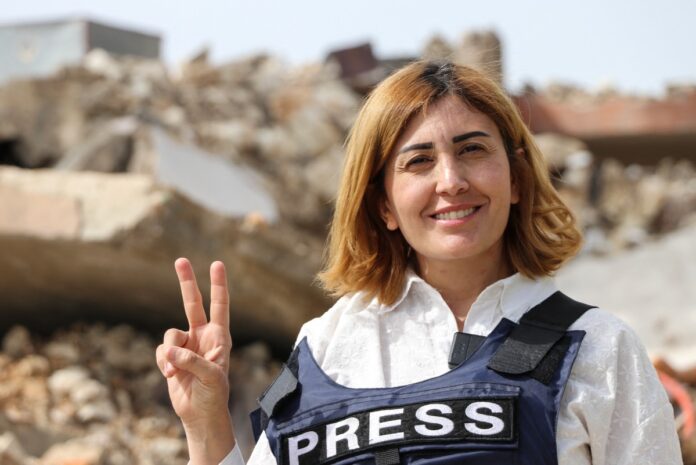
Allegations of Israeli attacks targeting journalists in southern Lebanon have escalated into a new diplomatic and humanitarian crisis. In a joint statement, Lebanon’s president and prime minister accused Israel of committing a war crime following an airstrike in the Israeli-occupied south that killed a Lebanese journalist.
Lebanese field reporter Amal Halil, who worked for Al-Akhbar, was killed when the house she had taken refuge in while fleeing Israeli strikes was bombed. The incident drew widespread attention, as it occurred despite direct death threats and a public rescue appeal made by Lebanon’s president.
Explicit death threats from an Israeli number
According to Lebanese media reports, the 42 year-old journalist received WhatsApp messages on the day of the attack from a phone number with Israel’s +972 country code. The first message referenced her reporting in southern Lebanon, where she had been documenting funerals and hospitals:
“You go from one village to another, but you still haven’t visited enough funerals and hospitals. Behind the smile you try to show on Twitter, there is a lot of pain. Is your house still standing?”
The second message contained a direct threat:
“We know where you are and we will reach you when the time comes. If you want to keep your head on your shoulders, I suggest you flee to Qatar or somewhere else.”
Lebanese sources said the messages were sent due to Halil’s field reporting documenting the destruction caused by Israeli attacks.
Vehicle ahead struck
Halil had been covering recent attacks near Bint Jbeil in southern Lebanon on Wednesday together with freelance photojournalist Zeynep Faraj. According to a timeline published by Al-Akhbar, at 14:45, a vehicle traveling ahead of the journalists’ car was struck by an Israeli drone. Two men inside that vehicle were killed. Following the strike, Halil and Faraj took shelter in a nearby house.
House bombed despite presidential intervention
At 14:50, Halil contacted her editors and family, informing them that they were trapped. The situation quickly became a national issue. Lebanese President Joseph Aoun issued an official statement calling for the Red Cross, in coordination with the Lebanese army and the United Nations, to urgently reach the two journalists.
However, according to Al-Akhbar, at 16:27 – after the president’s appeal – the house where the journalists were sheltering was bombed by Israel. All contact with them was lost following the strike.
Lebanon’s Health Ministry stated that Israeli forces had “tracked” the journalists who fled the initial attack and deliberately targeted the house where they were hiding.
Red Cross ambulances fired upon
Lebanese authorities also reported that rescue efforts were obstructed. According to the Health Ministry, a Red Cross ambulance dispatched to the scene was hit with a stun grenade and came under fire. The state news agency reported bullet marks on the Red Cross vehicle that transported the wounded journalist Faraj to Tibnin Government Hospital.
Rescue teams initially managed to evacuate Faraj in critical condition and recover the bodies of two civilians. However, due to continued bombardment, they could not reach Halil. When teams later re-entered the area, they recovered her body.
“A clear war crime”
Lebanese Prime Minister Nawaf Salam accused Israel of committing a clear war crime. He stated that targeting journalists, obstructing rescue teams, and striking the same location again constituted serious violations of international law.
Press freedom groups react strongly
Press freedom organizations also condemned the incident. The U.S.-based Committee to Protect Journalists said it was “horrified” by Halil’s killing. Its Middle East director Sara Qudah stated: “A repeat strike on the same location, the bombing of a place where journalists sought refuge, and the obstruction of medical aid constitute grave violations of international humanitarian law.”
Reporters Without Borders also said it had contacted the Israeli military to allow ambulance access. The organization’s executive Clayton Weimers described the incident as “not only a deliberate killing of a journalist but also an act of cruel indifference.” RSF added that it had serious concerns the strike on the shelter was intentional.
Israel denies allegations
The Israel Defense Forces rejected the accusations. In a statement, it said journalists were not targeted and claimed that the vehicles struck had exited a Hezbollah military facility. The IDF also denied obstructing rescue access and did not directly confirm Halil’s death.
Fourth journalist killed in recent weeks
Lebanese media had previously reported that Halil had received death threats allegedly originating from Israeli sources. Earlier this month, journalists including Ghada Dayekh of Sawt al-Farah radio and Suzan Halil of Al-Manar TV, as well as staff from Al-Mayadeen and Al-Manar, were also killed in Israeli strikes.
With Halil’s death, at least four journalists have reportedly been killed in Lebanon while on duty since early March.