


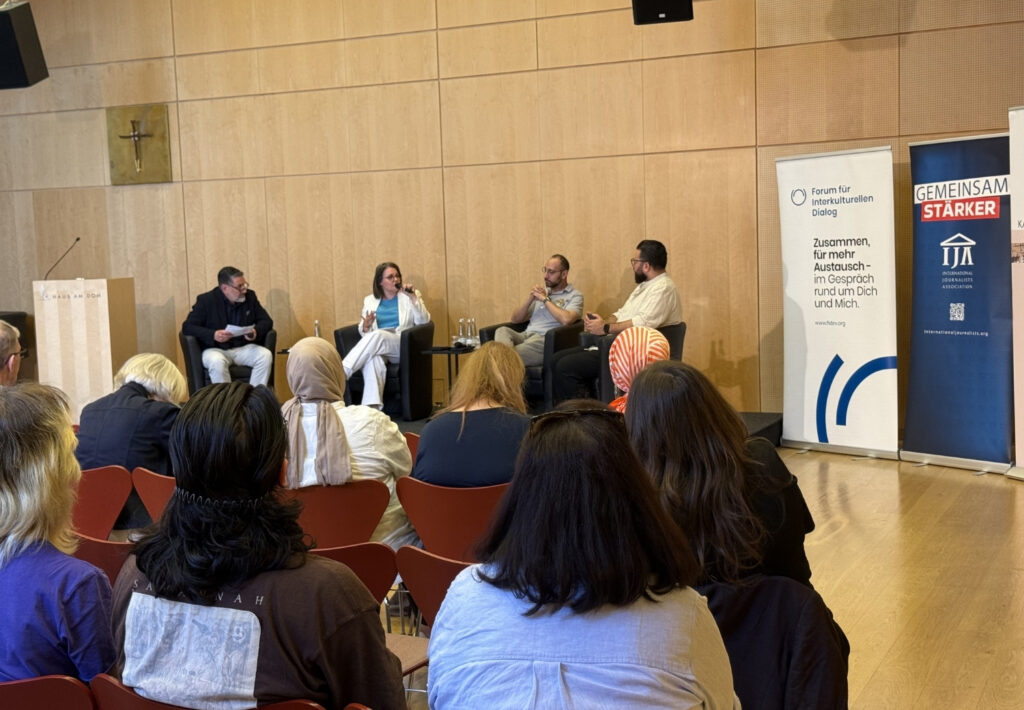
The second event in the AGORA FFM series focused on the growing flow of information in the digital age and its impact on democracy.
The event, titled “Media, Power and Public Opinion,” was organized in Frankfurt through a collaboration between the Agora FFM project of Forum für Interkulturellen Dialog e.V. (FIDeV), Haus am Dom and the International Journalists Association (IJA) e.V.
Held at Haus am Dom before a full audience with a notably young crowd, the event was moderated by ZDF editor and Islamic scholar Abdul-Ahmad Rashid. Discussions centered on how media dynamics shape political views and how “free” freedom of thought remains in the digital age.
The Foundation of Democracy: Face-to-Face Interaction Instead of Digital Reactions
The event opened with remarks by FIDeV Managing Director Kadir Boyacı, who summarized the core philosophy of the Agora FFM project:
“Democracy thrives through informed citizens, diverse perspectives and, above all, open dialogue.”
Boyacı emphasized that in an era of growing polarization and social tensions, physical spaces where people can come together and engage in respectful conversation are of vital importance.
“Social cohesion cannot be achieved through digital communication alone, it requires face-to-face interaction, listening and dialogue.”
Shifting Power Dynamics: Podcasts and “Mind Hunters”
One of the evening’s central themes was the declining influence of traditional media and the rise of digital platforms.
Navid Wali, an educator working in the field of countering extremism, highlighted the growing power of alternative platforms. He pointed in particular to podcast formats, which allow radical figures to speak at length and without filters.
“That reach is power itself. Digital spaces empower communities. Echo chambers are no longer small; they are forming large communities.”
Wali noted that socially isolated young people are especially vulnerable. While radical groups once operated primarily on the streets, he said, social media now brings the process directly into people’s homes.
“A 13-year-old child who is being bullied can suddenly receive attention and acceptance through a livestream. At first, it’s not ideology that matters – it’s the need to feel valued. That is something malicious actors can exploit.”
New Forms of Radicalization
Prof. Dr. Vera Pirker of Goethe University Frankfurt said similar trends can also be observed within Christian communities. She noted that Bible study sessions now increasingly take place through TikTok and Instagram broadcasts.
Pirker argued that online environments can create a sense of being part of a minority, which may reinforce more conservative tendencies.
She also observed that interest in long-form content is growing again, helping explain the popularity of podcasts that run for several hours.
The Internet as a Chameleon: Manipulation and Fake News
Sociologist and former Frankfurt SPD city council member Omar Shehata discussed the manipulative power of social media, citing Frankfurt’s Ramadan lighting project as an example.
Although the project was generally well received in real life, it was distorted on social media and transformed into content designed to provoke outrage.
“The internet is like a chameleon. False information spreads, and people are judged based on whether they appear ‘German’ or not.”
Shehata noted that criticism came not only from outside the Muslim community but also from within it, as some believed such initiatives could strengthen far-right narratives.
The Risks of Artificial Intelligence
The impact of artificial intelligence was also discussed during the panel. Navid Wali warned that radical groups are increasingly using AI tools.
He explained that these tools are being used to create persuasive, lengthy videos based on religious texts and highlighted the dangers involved:
“This eliminates the individual’s capacity for interpretation. Everything is presented in a ready-made form.”
Panelists also noted that AI-powered bot networks are being used to manipulate online discussions and suppress opposing viewpoints.
According to research cited during the discussion, radical groups account for only a small number of people but exert a disproportionately large influence on social media content.
Conclusion: What Protects Democracy?
The panel concluded with a discussion of possible solutions. Participants agreed that banning social media platforms would not be the right answer.
Instead, they emphasized the need to strengthen media literacy within educational systems.
Prof. Pirker argued that people should approach the digital world more calmly and thoughtfully:
“We do not have to express an opinion on everything immediately. We can take time to consider different perspectives.”
The final message focused on the importance of face-to-face communication. Omar Shehata stressed that no algorithm can replace human interaction:
“We need spaces where people can express themselves. Nothing can replace respectful, face-to-face dialogue.”
In this regard, the Agora project continues to play an important role by creating such spaces. The event series is supported by the City of Frankfurt am Main and the Department for Multicultural Affairs (AMKA).