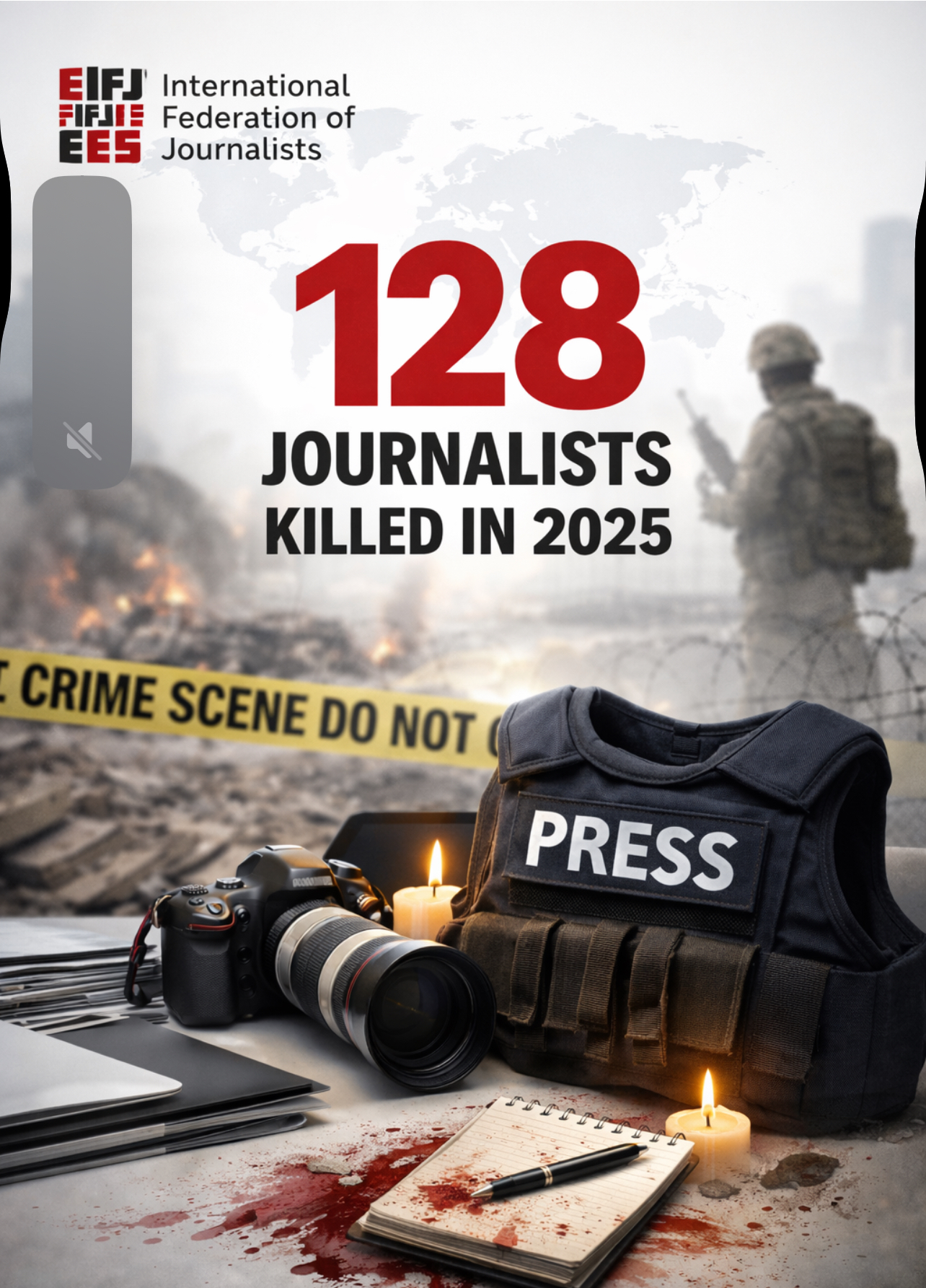
The International Federation of Journalists (IFJ) has published its final list of journalists and media workers killed in 2025, revealing a grim global picture for press freedom. According to the report released on 31 December, 128 journalists and media professionals lost their lives worldwide during the year, including ten women. Nine of the deaths were classified as accidental. The IFJ describes 2025 as yet another deadly year for journalism and sharply criticises the ongoing failure of authorities to adequately protect media workers.
Compared with the preliminary list published on 9 December, which recorded 111 deaths, the final update confirms 17 additional cases. The revised figures underline both the extreme dangers faced by journalists and the persistent culture of impunity surrounding crimes against the media. Newly confirmed deaths were reported from Palestine, Tanzania, Peru and Guatemala. The list also includes several accidental deaths, among them seven media workers in Nigeria and one each in Burundi and Iran.
Since launching its annual Killed List in 1990, the IFJ has documented 3,173 deaths of journalists and media workers worldwide – an average of 91 per year – with 876 killings recorded over the past decade alone. Alongside the death toll, the Federation also published a list of 533 imprisoned journalists globally, with China remaining the world’s largest jailer of media professionals.
For the third consecutive year, the Middle East and Arab World emerged as the most dangerous region for journalists. A total of 74 media workers were killed there in 2025, accounting for 58 per cent of all global deaths. Of these, 56 occurred in Palestine, largely as a result of the war in Gaza. Yemen ranked second with 13 deaths, followed by Ukraine with eight. Sudan reported six killings, while India and Peru each recorded four. Several other countries, including the Philippines, Mexico, Peru and Pakistan, lost three journalists each, highlighting the concentration of risk in conflict and crisis zones.
In the Asia-Pacific region, 15 journalists were killed in 2025, while the region continues to lead the world in the imprisonment of media workers, with 277 journalists currently behind bars. Europe recorded ten killings, most of them linked to the war in Ukraine. The IFJ expressed particular alarm at the growing use of drones to deliberately target journalists and their vehicles.
In Africa, nine media workers were killed in targeted attacks, primarily in Sudan, alongside several accidental deaths, including a fatal road accident involving journalists in Nigeria. Across the Americas, 11 journalists were killed, with Peru emerging as a particularly worrying case after years without fatal attacks on media workers.
IFJ General Secretary Anthony Bellanger described the figures as evidence of a “global crisis”. He warned that 128 journalists killed in a single year is not merely a statistic, but a stark reminder that media workers are being targeted with impunity simply for doing their jobs. Bellanger called on governments to act urgently to protect journalists, bring perpetrators to justice and defend press freedom, stressing the need for a United Nations convention to guarantee the safety and independence of journalists worldwide.