Thursday, June 4, 2026
Join Us
International Journalists
  • News
  • Activities
    • IJA Academy
  • Projects
  • Reports
  • About Us
    • About Us
    • Charter
    • Commitment to Gender Mainstreaming and the Empowerment of Women
  • Journalist Post
  • English
No Result
View All Result
  • News
  • Activities
    • IJA Academy
  • Projects
  • Reports
  • About Us
    • About Us
    • Charter
    • Commitment to Gender Mainstreaming and the Empowerment of Women
  • Journalist Post
  • English
No Result
View All Result
International Journalists
No Result
View All Result

Reporters Without Borders: Turkey Ranks 163rd in Press Freedom

R. Hale Seferoğlu by R. Hale Seferoğlu
30/04/2026

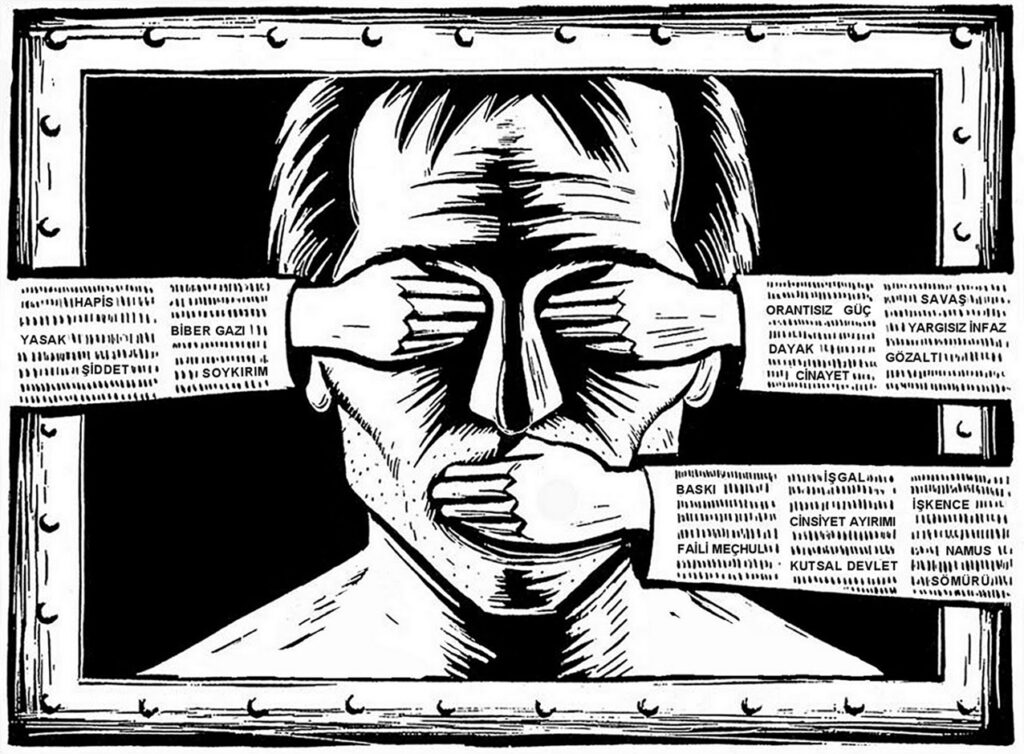
According to the 2026 World Press Freedom Index published by Reporters Without Borders (RSF), Turkey ranks 163rd out of 180 countries. The report highlights that pressure on journalists, arrests and legal practices targeting freedom of expression have become systematic.

Press freedom declining globally

The 2026 World Press Freedom Index reveals that press freedom worldwide has fallen to its lowest level in the past 25 years. For the first time in the index’s history, 52.2 percent of countries are classified as being in a “difficult” or “very serious” situation. The global average score has dropped to its lowest point since the index was first published.

According to the report, the sharpest decline among the five indicators affecting press freedom (economic, legal, security, political, and social) occurred in the legal framework. In the 2025-2026 period, deterioration in the legal indicator in 110 out of 180 countries shows that journalism is increasingly being treated as a crime.

Turkey ranked 163rd

Turkey placed 163rd in the 2026 Index. RSF noted that accusations such as “disinformation”, “insulting the president” and “denigrating state institutions” are routinely used as tools to suppress journalism and imprison journalists in the country.

The report emphasized that this approach goes beyond anti-terror legislation, with broader legal regulations restricting freedom of expression becoming one of the main instruments of pressure on journalists.

RSF: “How much longer will we tolerate the suffocation of journalism?”

RSF Editorial Director Anne Bocandé stated, on the occasion of the index’s 25th anniversary, that attacks on press freedom have become more overt and systematic. She said:

“How much longer will we tolerate the suffocation of journalism, the systematic obstruction of journalists, and the constant erosion of press freedom?
Authoritarian states, failing political actors, predatory economic forces, and unregulated platforms all bear direct responsibility for this decline.”

Bocandé warned that remaining passive effectively amounts to endorsing this process and called for the implementation of strong and active protection policies for journalists.

Five key takeaways from the 2026 ranking:

  1. The global average score has never been this low. For the first time in 25 years, more than half of all countries (52.2 percent) are classified as being in a “difficult” or “very serious” situation.
  2. Among the five indicators measuring press freedom worldwide (economic, legal, security, political, social) the legal framework saw the steepest decline this year.
  3. The United States fell seven places to 64th, while countries such as Ecuador and Peru also recorded significant drops.
  4. Norway ranked first for the tenth consecutive year, while Eritrea has remained at the bottom for the past three years.
  5. Syria after the Assad regime (ranked 141st) recorded the biggest improvement in 2026, rising 36 places.

Wars and impunity threaten the press

The report underlines that journalists face life-threatening risks in conflict zones such as Iraq (162nd), Sudan (161st) and Yemen (164th). It also reports that more than 220 journalists have been killed since October 2023 in attacks carried out by Israeli forces in Gaza.

Highlighting the global prevalence of impunity, the report states that in more than 80 percent of countries, effective protection mechanisms for journalists are either absent or non-functional.

Decline in the US and Latin America

In the 2026 Index, the United States dropped seven places to 64th. The report also notes that organized crime, violence, and security related pressures continue to undermine press freedom across Latin America.

While Norway maintained its top position for the tenth consecutive year, China, North Korea and Eritrea remained among the lowest-ranked countries, with Eritrea holding last place for three years in a row.

Legal pressure becomes a global trend

According to RSF, criminalizing journalism through anti-terrorism, national security or “fake news” laws has become a global trend. The report also points to increasing legal pressure in countries such as India, Egypt, Israel and Georgia.

It concludes that restrictions imposed under the pretext of national security are eroding the public’s right to access information and making it increasingly difficult for journalism to fulfill its core function.

TweetSendShare

Who we are

Address: Am Hauptbahnhof 16, 60329 Frankfurt

Phone : +49 179 1385035

Email : [email protected]

Support Us

IBAN: DE29 5065 2124 0004 1249 13 Sparkasse / BIC: HELADEF1SLS

Journalist Post

Newsletter

Leave your e-mail address for the newsletter subscription.

Email Address *

Welcome Back!

Login to your account below

Forgotten Password?

Retrieve your password

Please enter your username or email address to reset your password.

Log In

Add New Playlist

Manage Consent
To provide the best experiences, we use technologies like cookies to store and/or access device information. Consenting to these technologies will allow us to process data such as browsing behavior or unique IDs on this site. Not consenting or withdrawing consent, may adversely affect certain features and functions.
Functional Always active
The technical storage or access is strictly necessary for the legitimate purpose of enabling the use of a specific service explicitly requested by the subscriber or user, or for the sole purpose of carrying out the transmission of a communication over an electronic communications network.
Preferences
The technical storage or access is necessary for the legitimate purpose of storing preferences that are not requested by the subscriber or user.
Statistics
The technical storage or access that is used exclusively for statistical purposes. The technical storage or access that is used exclusively for anonymous statistical purposes. Without a subpoena, voluntary compliance on the part of your Internet Service Provider, or additional records from a third party, information stored or retrieved for this purpose alone cannot usually be used to identify you.
Marketing
The technical storage or access is required to create user profiles to send advertising, or to track the user on a website or across several websites for similar marketing purposes.
  • Manage options
  • Manage services
  • Manage {vendor_count} vendors
  • Read more about these purposes
View preferences
  • {title}
  • {title}
  • {title}
Manage Consent
To provide the best experiences, we use technologies like cookies to store and/or access device information. Consenting to these technologies will allow us to process data such as browsing behavior or unique IDs on this site. Not consenting or withdrawing consent, may adversely affect certain features and functions.
Functional Always active
The technical storage or access is strictly necessary for the legitimate purpose of enabling the use of a specific service explicitly requested by the subscriber or user, or for the sole purpose of carrying out the transmission of a communication over an electronic communications network.
Preferences
The technical storage or access is necessary for the legitimate purpose of storing preferences that are not requested by the subscriber or user.
Statistics
The technical storage or access that is used exclusively for statistical purposes. The technical storage or access that is used exclusively for anonymous statistical purposes. Without a subpoena, voluntary compliance on the part of your Internet Service Provider, or additional records from a third party, information stored or retrieved for this purpose alone cannot usually be used to identify you.
Marketing
The technical storage or access is required to create user profiles to send advertising, or to track the user on a website or across several websites for similar marketing purposes.
  • Manage options
  • Manage services
  • Manage {vendor_count} vendors
  • Read more about these purposes
View preferences
  • {title}
  • {title}
  • {title}
No Result
View All Result
  • News
  • Activities
    • IJA Academy
  • Projects
  • Reports
  • About Us
    • About Us
    • Charter
    • Commitment to Gender Mainstreaming and the Empowerment of Women
  • Journalist Post
  • English
Join Us