“We want to create spaces for new perspectives, for open debates – and for voices that are too often unheard.”
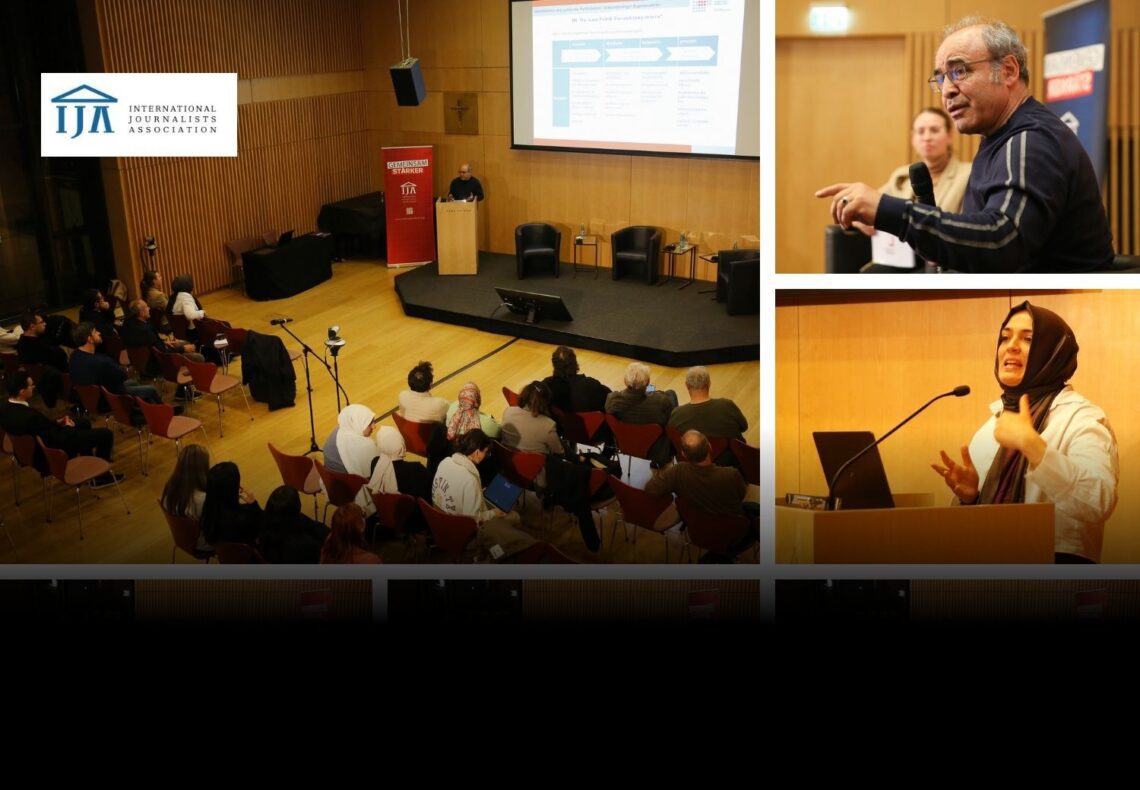
With these words, journalist Ebru Kaymak (Deutsche Bold) opened the third edition of the Frankfurter Gespräche, a joint series by Haus am Dom and the International Journalists Association (IJA).
Kaymak, an editor at Deutsche Bold, moderated the evening with clarity and precision – driven by the conviction to “not only talk about debates, but make them transparent.”
She is part of the Bold Media Group, which, through its platforms Deutsche Bold, Bold Medya, Bold Puls, and Bold View, has built Germany’s first multilingual, non-profit media network. The group’s mission is to expand the public discourse across linguistic, cultural, and generational boundaries while fostering independent, dialogue-oriented journalism.
The evening took place at a symbolic moment – exactly one year after the collapse of the “traffic-light coalition”and six months into the new government’s term. It was a fitting time to ask: what has truly changed in Germany’s political and social climate? Where does trust grow – and where does uncertainty persist?
Kaymak set the tone early:
“At a time when social cohesion is under pressure, we are interested in the concrete: what is actually changing – in daily life, in the media, in people’s minds?”
Political Participation, Identification – and the “Integration Paradox”
The analytical opening was delivered by Prof. Dr. Hacı-HalilUslucan, Director of the Center for Integration Research at the University of Duisburg-Essen and a member of the Federal Commission on Integration Capacity.
Combining empirical data with psychological insight, he argued that integration is impossible without self-efficacy.
“Human beings have a fundamental need for control. Political participation – and thus naturalization – turns people from objects of political management into subjects of politics.”
Where communities lack voting rights, Uslucan noted, politicians can talk about them without fear of being voted out. “Those who have a voice change the very language used to describe them.”
He explained the integration paradox: young people who are objectively well integrated – linguistically, socially, educationally – often feel less included.
“They perceive inequality more sharply. That’s not a weakness but progress: the principles of equality have been internalized. When they are violated, people rebel – and that rebellion is a democratic signal.”
With a vivid metaphor, he described generational change:
“The first generation is grateful to get a piece of cake. The second asks whether it’s fairly shared. The third wants to decide which cake to bake.”
His conclusion: successful integration brings more conflict, not less, because participation breeds confidence. “Belonging shouldn’t mean gratitude – it should mean equality.”
Citing the federal Integration Barometer, he called Germany’s progress “not a failure, but still a work in progress,” noting that people of Turkish descent report higher levels of exclusion.
“Subjective integration isn’t a luxury – it’s the foundation of democratic loyalty.”
Integration, he emphasized, is not a one-sided task:
“Integration capacity is not a burden on migrants but a shared social responsibility – realized where education, work, and political participation meet.”
Media Between Outrage and Responsibility
The second impulse came from Yasemin Aydın, journalist with a background in social anthropology and psychology, and Director of International Relations & Public Engagement at the IJA.
She shifted the focus to media accountability:
“Media are no longer neutral transmitters – they are resonance chambers in which society senses who belongs and who remains outside.”
Using the recent “cityscape” controversy as an example, Aydın showed how vague questions and sensational headlines fuel outrage while blurring substance.
“A just public sphere is not measured by the volume of its scandals but by the proportionality of its attention.”
She criticized the persistent underrepresentation of people with international backgrounds in mainstream media, noting that when they do appear, it is mostly in the context of migration or crisis.
“Diversity exists in society – but not yet in the newsrooms. Those who never tell their own stories remain objects, not authors, of the public sphere.”
Aydın proposed three guiding principles for responsible journalism:
“In Germany, we often talk about belonging as if it were a permit. But it’s not about approval – it’s aboutrelationship.”
Being “Tolerated,” Speaking Many Languages – and the Power of Words
In the panel and audience discussion, the focus turned to what cannot be measured yet defines social cohesion: the feeling of truly belonging.
A young participant asked: “What does it do to people psychologically when they live in a country for years but still feel merely tolerated?”
Uslucan replied:
“‘Tolerance’ is not a concept of equality – recognition is. Those who must constantly explain themselves cannot unfold freely.”
He described this “state of being tolerated” as a form of permanent vigilance, an inner alertness that prevents people from feeling at home:
“Those dependent on someone else’s goodwill are always standing in a symbolic waiting line.”
Aydın expanded the thought to a cultural level, describing what she called the ‘emotional grammar of belonging’:
“We talk about belonging in Germany as if it were a license. But belonging is built through relationship – not regulation.”
She emphasized that political and media language powerfully shape this climate of inclusion:
“The words we use – ‘cityscape,’ ‘flood,’ ‘burden’ – carry emotional codes. When repeated uncritically, they push entire groups to the semantic margins.”
A student then asked whether multilingualism was a barrier or a strength for young people.
Uslucan’s answer was clear:
“Bilingualism is a resource – cognitive, social, emotional. Thinking in several languages widens one’s field of perception.”
Aydın added a structural dimension:
“Not all languages enjoy the same prestige. French-German is seen as cosmopolitan; Turkish-German as a challenge. Both express the same human ability – to think between worlds.”
She urged policymakers and media alike to treat multilingualism as a democratic competence, not a deviation:
“A society that thinks in only one language becomes blind to its own possibilities.”
Her conclusion was both ethical and personal:
“Recognition begins not with laws but with tone, with eye contact, with the willingness to listen.”
Visibility, Equality – and Justice as the Measure
In her closing words, Aydın turned reflection into appeal:
“I identify as a German with Turkish roots. My home is here – and precisely because of that, we must talk about language, meaning, and representation. Visibility creates normality.”
Uslucan concluded with philosopher John Rawls’ “veil of ignorance” thought experiment:
“Justice is what is equally good for everyone.”
Between empirical evidence and lived experience, between journalism and civic life, the evening made one one fact tangible: belonging grows where rights, representation, and respect meet – and where media help make that visible.