Thursday, June 4, 2026
Join Us
International Journalists
  • News
  • Activities
    • IJA Academy
  • Projects
  • Reports
  • About Us
    • About Us
    • Charter
    • Commitment to Gender Mainstreaming and the Empowerment of Women
  • Journalist Post
  • English
No Result
View All Result
  • News
  • Activities
    • IJA Academy
  • Projects
  • Reports
  • About Us
    • About Us
    • Charter
    • Commitment to Gender Mainstreaming and the Empowerment of Women
  • Journalist Post
  • English
No Result
View All Result
International Journalists
No Result
View All Result

CAN NOT CALL IT A “WAR”

Prison sentences of up to 15 years for choosing the wrong words, hundreds of exiled journalists and strict censorship on the Internet: Press freedom in the country has been largely abolished since Russia's aggression in Ukraine. But the Kremlin could expand the crackdown even further. Birger Schütz wrote for Journalist Post.

admin by admin
12/05/2023
CAN NOT CALL IT A “WAR”


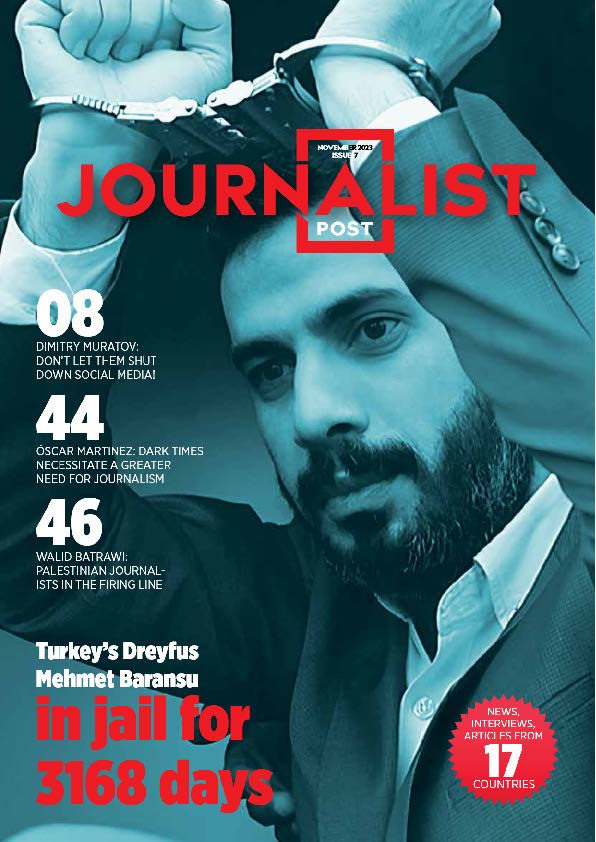
CLICK HERE to download Journalist Post 6


  •  It is forbidden to call the war ‘war’ 
  •  Kremlin has not yet used its weapons against journalists 
  •  It is forbidden to use words such as “attack”, “war”, “invasion” 
  • According to estimates, over a thousand journalists had to leave Russia 
  • Up to 15 years in prison for so-called false news

A few hours after Russia’s attack on Ukraine, an open letter appeared on the Internet. “War is not and never will be the right way to solve problems,”. It was signed by more than 70 Russian journalists. Other free media workers analysed the situation in a similar way. “War is madness” was the headline of the respected newspaper Nowaja Gaseta. It emphasised that the Ukrainian people are not the enemy. Prominent journalists signed open calls against the war, and many others criticised it on social media. 

However, these few reactions were largely ineffective. The government stepped up its repression of journalists. The flow of information was completely controlled and the dominant view of the war was determined by the state. On the first day of the attack, Roskomnadsor, the state organisation responsible for controlling the media, issued a warning. It pointed out that only information from official sources could be used in reporting on the war. It was forbidden to use words like “attack”, “war”, “invasion”. It was a “special operation”. Anyone who broke the rules was penalised. 

On the fifth day after the start of the invasion, the authorities blocked access to two of the most important figures in the independent media. These were the internet TV channels “Doschd” and “Echo Moskwy”. This decision caused widespread concern. “Nowaya Gaseta” also suspended its reporting for a month. 

The Duma, the Russian parliament, dealt the biggest blow to press freedom on 4 March 2022. It approved two laws. These laws provided for prison sentences of up to 15 years for the owners of news reports that allegedly gave false information about the military or for those accused of discrediting the military. The laws laid the foundations for military censorship. Any news that differed from the official statements of the Ministry of Defence was considered “fake news” and subject to punishment. 

Censorship on the internet was also toughened. Facebook, Twitter and Instagram were shut down in March and access to many addresses was blocked. Only Telegram and Youtube remained as independent sources of information. The new laws led to a mass exodus of Russian media workers. According to estimates, 30 news centres and over a thousand journalists have been forced to leave Russia. Most of them are now practising their profession in countries such as Georgia, Latvia and the Netherlands. 

The only news organisations left in the country are the propaganda channels, the newspapers of oligarchs close to the regime and a number of private regional media outlets. These either impose strict censorship on themselves or do not publish any news about the war. However, there are a few examples, such as the online newspaper “Ljudi Baikala” from Irkutsk, Siberia. This organisation is trying to overcome the censorship by publishing reports on the economic and social consequences of the war on a regional scale. 

However, despite the toughening of the laws, the number of journalists imprisoned in Russia remains relatively low. Seven journalists have been arrested since the war broke out and are currently in prison. 14 journalists have been released. But these developments are no cause for relief – quite the opposite. The Kremlin has not yet even needed to use most of its repressive tools to kill independent journalism in the country. It may therefore resort to more radical methods in the fight against press freedom. For example, mass arrests or, as has been discussed for months, a complete blocking of YouTube and a Belarusian style of internet censorship. In this neighbouring country, the use of VPN services or subscriptions to channels considered extremist are also punishable by criminal sanctions. 

– Birger Schütz is press officer for Russia, Eastern Europe and Central Asia at Reporters Without Borders (RSF). He studied political science, modern history and Russian studies in Greifswald and Irkutsk and worked as a reporter for the daily newspaper “Nordkurier”. He then worked for 2.5 years as a correspondent for the “Moskauer Deutsche Zeitung” in the Russian capital and later as Russia correspondent for the daily “Neues Deutschland”. 


TweetSendShare

Who we are

Address: Am Hauptbahnhof 16, 60329 Frankfurt

Phone : +49 179 1385035

Email : [email protected]

Support Us

IBAN: DE29 5065 2124 0004 1249 13 Sparkasse / BIC: HELADEF1SLS

Journalist Post

Newsletter

Leave your e-mail address for the newsletter subscription.

Email Address *

Welcome Back!

Login to your account below

Forgotten Password?

Retrieve your password

Please enter your username or email address to reset your password.

Log In

Add New Playlist

Manage Consent
To provide the best experiences, we use technologies like cookies to store and/or access device information. Consenting to these technologies will allow us to process data such as browsing behavior or unique IDs on this site. Not consenting or withdrawing consent, may adversely affect certain features and functions.
Functional Always active
The technical storage or access is strictly necessary for the legitimate purpose of enabling the use of a specific service explicitly requested by the subscriber or user, or for the sole purpose of carrying out the transmission of a communication over an electronic communications network.
Preferences
The technical storage or access is necessary for the legitimate purpose of storing preferences that are not requested by the subscriber or user.
Statistics
The technical storage or access that is used exclusively for statistical purposes. The technical storage or access that is used exclusively for anonymous statistical purposes. Without a subpoena, voluntary compliance on the part of your Internet Service Provider, or additional records from a third party, information stored or retrieved for this purpose alone cannot usually be used to identify you.
Marketing
The technical storage or access is required to create user profiles to send advertising, or to track the user on a website or across several websites for similar marketing purposes.
  • Manage options
  • Manage services
  • Manage {vendor_count} vendors
  • Read more about these purposes
View preferences
  • {title}
  • {title}
  • {title}
Manage Consent
To provide the best experiences, we use technologies like cookies to store and/or access device information. Consenting to these technologies will allow us to process data such as browsing behavior or unique IDs on this site. Not consenting or withdrawing consent, may adversely affect certain features and functions.
Functional Always active
The technical storage or access is strictly necessary for the legitimate purpose of enabling the use of a specific service explicitly requested by the subscriber or user, or for the sole purpose of carrying out the transmission of a communication over an electronic communications network.
Preferences
The technical storage or access is necessary for the legitimate purpose of storing preferences that are not requested by the subscriber or user.
Statistics
The technical storage or access that is used exclusively for statistical purposes. The technical storage or access that is used exclusively for anonymous statistical purposes. Without a subpoena, voluntary compliance on the part of your Internet Service Provider, or additional records from a third party, information stored or retrieved for this purpose alone cannot usually be used to identify you.
Marketing
The technical storage or access is required to create user profiles to send advertising, or to track the user on a website or across several websites for similar marketing purposes.
  • Manage options
  • Manage services
  • Manage {vendor_count} vendors
  • Read more about these purposes
View preferences
  • {title}
  • {title}
  • {title}
No Result
View All Result
  • News
  • Activities
    • IJA Academy
  • Projects
  • Reports
  • About Us
    • About Us
    • Charter
    • Commitment to Gender Mainstreaming and the Empowerment of Women
  • Journalist Post
  • English
Join Us